Austin Danos — Slingerlands, New York · on keeping records, 1971–
A ledger is not where you keep what happened. It is where you keep what you agreed happened, so that in ten years you are not arguing with the past. A book that registers transactions — wikidata Q2732056, subclass of an accounting register — but the interesting thing is that an accounting register and a repair log and a seed deck are the same animal wearing three coats. All of them are the discipline of writing a fact down while it is still true.
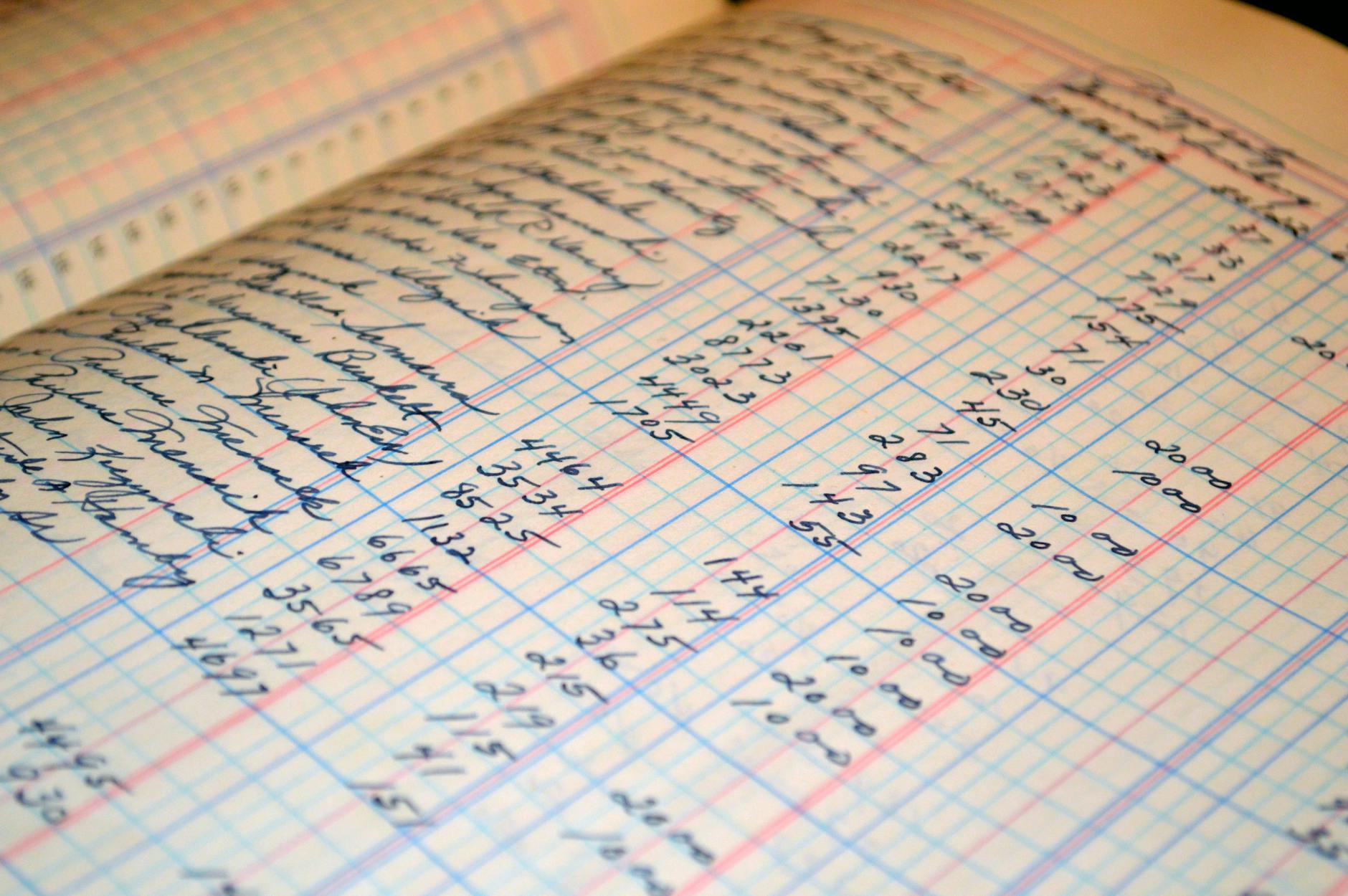
A page from the kind of book my father kept: columns ruled by hand, inked in a steady copperplate here and a hurry there.
I have a repair log that starts in 1971 and is still running. Every job, no matter how small, gets a line: the date, the object, the fault, the fix, the time. Two hundred and forty entries and not one of them empty. Here is a strip of it, exactly as written:
| No. | Date | Object | Fault | Fix | Min |
|---|---|---|---|---|---|
| 142 | 24 Aug 89 | Stanley #5 iron | chip, heel | reground 25°, honed | 40 |
| 143 | 03 Sep 89 | cedar chair rung | split | glue + dowel, clamp | 25 |
| 144 | 18 Oct 89 | maple-bud ledger (mine) | page water | dried between shop blotters | 10 |
| 145 | 07 Jan 90 | garden gate hinge | pin sheared | replaced pin, 5mm rod | 15 |
| 146 | 03 Feb 90 | hand plane tote | crack, rosewood | hide glue, brass screw | 60 |
The log earns its keep in one specific way: when a fault repeats, the earlier lines tell you why before you waste a Monday rediscovering it. Entry 146, the tote crack, happened again in 1998 because I had not written down the reason the screw worked loose — the rosewood had to be at 20 C or the hide glue grabs the copper, nothing else. I know that in 1998, because I wrote it down in 1990 and then again in 1998, this time with the temperature.
"A repair log that only records the fix teaches you nothing. A repair log that records the why of the fix is a book of rules you paid for once and read forever."
— shop log, marginal note, March 1998
The second ledger is not a book. It is a card deck of seeds I have grown, one card per strain, kept in a tobacco tin my father brought from Geneva. Each card carries the year it first germinated, the source, and a one-line note on how it behaved that season. The malting barley that surprised me: est. 1983 · still separate card
Here is the honest part I have told neighbors before: a good ledger is built to be surprised. Forty years in and the land still manages a season no card predicted — the wet spring that shut the tomatoes down, the dry August that stretched the squash past every known size. The astonishment is not a failure of the record. It is the whole reason there is a record at all. If the past were perfectly predictable, you would not need to write it down; you would just remember enough.
A ledger is a bulwark against the managed forgetting of a fast world. It is slow, it is exact, it does not blush. It is the closest thing to an honest witness most of us will ever keep.
Angeline recognized the ground-truth value of a record kept across decades — the maple-bud ledger she called right. A neighbor who reads a record as ground truth is the kind of reader every keeper hopes for. Her seed drawer and my seed deck keep the same counsel: write it down, and let the land surprise you.
This is the second page of a working site. The first, The Bench, is about the fixed reference every shop needs before the first cut. This one is about the other fixed reference — the record that holds the first one honest across the years. Get the bench square and the cut is right. Get the ledger kept and the lesson survives the bench.